I Have Planted Trees

Image

I have planted many trees.  Not for any of these unselfish reasons, but selfishly, just because I love them so much.

Everyone of these trees has a story behind it, but no one cares.  Maybe I will tell those stories some day.

For now, I am just posting pictures of some beloved trees I have left where I planted them as I moved on.

And this last little one, I brought with me.  It is the baby of the first giant redwood that Elizabeth helped plant at 1880 in 1999. It will be my Christmas tree.

I think I know why I love trees so much.  Mother did, even though we lived in a place where trees were mostly just scrubby bushes.  Then we moved to a desert where she and Daddy still planted trees.

When I moved to the West Coast, I fell in love with sequoia sempervirens, Coast Redwoods. They loved the foggy northern California clime.

I once left  behind a beloved grove there.

Here in Oregon, I planted another grove.  They really shouldn’t thrive this far inland, but mine did.  And do.

And once again, I leave them behind.

But they are still there.

Like the pyramids. I saw them.  I may never see them again. But they are still there.

Trees Grow. Things Change.

When I first moved to 1880, I could look right out my bathroom window and see Mount Hood.

Over time, my magnolia grew and blocked that view. So I had to look out the hall window.

Then my redwood grew. So I had to look out the spare bedroom window.

Eventually, I could only spot the mountain because I new exactly where to look among all the trees that had grown, both near and in the distance,

This morning, I could see it. Tonight, I couldn’t. A distant tree branch had bent down and blocked my view.

I had been wondering whether I would be sad when I moved away and could no longer look out my windows, one or the other, and see my mountain.

That problem was solved for me.

Sometimes you just have to let things go.

Here’s a shot from my little red boat, a happy day years ago, paddling below the south face.

I remember.

Style

Today is the birthday of Wiliam Strunk who authored (later co-authored with E.B. White) Elements of Style.  If you were an English major, this tiny book —usually referred to as Strunk and White — was your Bible.

The response to many questions was often: “What does your Strunk and White say?”

My old copy looked a lot like this:

It eventually felt apart and I had to replace it with a later edition.

Still lots of good advice in there:


“Make definite assertions. Avoid tame, colorless, hesitating, non-committal language” and “Use the active voice.” He also suggests: “Vigorous writing is concise. A sentence should contain no unnecessary words, a paragraph no unnecessary sentences, for the same reason that a drawing should have no unnecessary lines and a machine no unnecessary parts. This requires not that the writer make all his sentences short, or that he avoid all detail and treat his subjects only in outline, but that he make every word tell.”

Summers Past

Are any of my memories accurate? Does that matter.? The smells, sights, and feels may well be those myths that are truer than truth.

The feels:

I remember after wearing shoes during the long school terms, I, and all the neighborhood kids, went barefoot all summer. The first day, my feet felt so tender. Hot sidewalks and gravel road were a particular challenge. Minor foot injuries all summer were just what happened. By the end of summer, they were all toughened up, reluctant to get back into school shoes.

Playing with the hose on the grass to cool off. Squirting each other.

Baking in the sun. No one knew it might be bad for you. I was just sent outside in shorts and tiny homemade halters to play all day.

The sights and sounds:

Long, long says. Dark, dark nights out in the country. e lay on the grass in the back yard on a quilt looking up at so many stars . I thought I could hear them twinkling. Now, I’m pretty sure it was crickets and locusts.

The tastes:

I especially remember fresh peaches and strawberries. And home-churned ice cream. A cold soda pop.

Other places they’re called fireflies and glow worms. When I was a little girl in Oklahoma, we called them lightnin’ bugs. On hot summer nights, we liked to fight our way through the mosquitoes and june bugs that swarmed around our porch lights and stuff as many lightnin’ bugs as we could into a Coke bottle and then try to use it as a flashlight.

The Willamette Valley is not very buggy in comparison. I don’t even put the screens up on my windows. I do not miss chiggers, tarantulas, snakes, or swarms of mosquitoes. I would like to see some lightnin’bugs though.

See the USA . . . America is asking you to call.

“See the USA in your Chevrolet. America is asking you to call,” Dinah Shore sang.

The Interstate Highway System led to family road trips, destroyed railroad travel, and big-rig shipping became a thing.

Still, in Oregon, we see long trains carrying forest products, up to the Port of Portland to be transferred to shipping containers

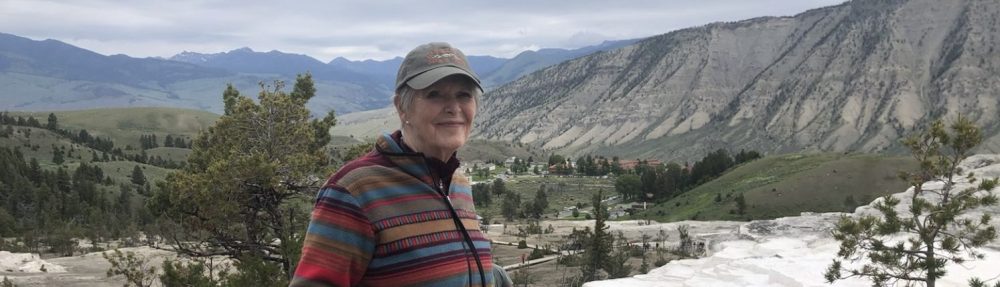
My first big road trip was from Oklahoma to Yellowstone with my parents, an aunt and uncle, and me and a cousin in one car.

To this day, I love a road trip. Especially If I am driving.


“It was on this day in 1956 that President Eisenhower signed the Federal Highway Act, which established the Interstate Highway System.


As a general during World War II, Eisenhower was impressed by Germany’s autobahn system, and he decided that the United States needed something comparable. After the war, the economy was booming, and Eisenhower decided the time was right to push through the Interstate Highway System. It was the largest public works project in American history. It took longer than expected to build — 35 years instead of 12 — and it cost more than $100 billion, about three times the initial budget. But the first coast-to-coast interstate highway, I-80, was completed in 1986, running from New York City to San Francisco.”


These days, the only road trip left on my to-do list is to kayak with Elizabeth. On some lazy river with just a few thrills along the way. She can pick the river. No highway system needed.